Origins of the Hawaiian Shirt
Palaka shirts are recognizable throughout the world as a part of Hawaiian culture. Little has changed throughout time including the material used. One cliché that comes to mind is ‘styles always come back’, for this shirt style has never gone out. One wouldn’t think of trees being used to make clothing, but for centuries it has been and still is used. Since the time the Polynesians discovered and settled into what is now Hawaii in 400 A.D. there have been many traditions that are still being used to this day. Most Hawaiian customs use natural means meant to preserve the environment around them and honor the living earth that they use in their everyday life. There is an amazing process still being used to this day for making of what is known as Tapa. This process originated in Tahiti and has been carried over as a tradition for centuries. Used for ceremonial and functional use, the Tapa cloth is also found used for the ever popular Palaka shirts as well as wall tapestries in many Hawaiian homes. The Palaka shirt that uses this unusual material has an interesting story in itself. Coming from other countries in Asia such as China and Japan, the Hawaiian field laborers found in their hands shirts with tails. To help protect them from the hot sun the workers improved the shirts for more practical use by taking off the tails and making them of light loose fitting material instead of the rich embroidered silks they were originally made in. These now traditional Palaka shirts are sometimes seen with the darker print on the inside showing the faded patterns on the outside. It appears the shirt is worn the wrong way, but this is really the way they were created to show the muted pattern. Usually found in traditional basic colors such as black or brown, but are also made in a multitude of colors and fabrics. Tapa fabric is not a very sturdy fabric and tends to be used more for the higher ceremonial purposes and special occasions. It is seen sometimes worn by government officials, chiefs and in weddings. The Tapa cloth is known by many different names in many places, Tangaas knows it as ‘Ngatu’, Samoa call it ‘Siapo’, in Fiji it’s called ‘Masi’ and in Hawaii it is also know as ‘Kapa’. Although it has different names making the Tapa is still the same process handed down from generation to generation. The material comes from the native breadfruit or paper mulberry trees commonly known as bark cloth. For the process of making this cloth narrow strips are taken from the trees and soaked in water until they are soft. The strips are then pounded by mallets called ‘ike’ until they are large thin strips. A natural glue named ‘tou’, of manioc root juice, bread fruit juice or arrow root is used to keep the edges glued together. After the cloth sheets are set printing plates are made of hibiscus bark and coconut fiber. Usually the designs for these plates are images and symbols of Hawaiian life. Hibiscus blossoms, flowers, fish, lizards and leaves are just some of the symbols one can expect to see on these beautiful cloths. Sometimes, coat of arms patterns can be found printed on this material. Patterns are usually set in a diagonal cross and simplistic in their design. Typical clothes are dyed black or reddish brown using natural substances such as clay and tree sap. This material could be found in about every home usually on shirts, decorative quilts or wall ornaments. Tapa that are given by a chief or royal family holds more value and most often time will be displayed in the home. Because the process is completely made of and with natural sources it is friendlier to the environment. Even the brushes used to apply the natural dyes and paints are made from sticks with frayed ends. Simplistic and beautiful from a culture that respects nature and tradition in an ever changing modern world it’s good to know that with tradition the old customs of Hawaii still find a place in today’s society. Because real tapa is time consuming to make, fragile and rare, most products touted as tapa nowadays contain the designs you would find on a tapa fabric, except for they are made from polycotton, cotton or barkcloth fabrics. Wave Shoppe offers this tribal tapa Hawaiian shirt in a design that is one of the best looking prints available. |
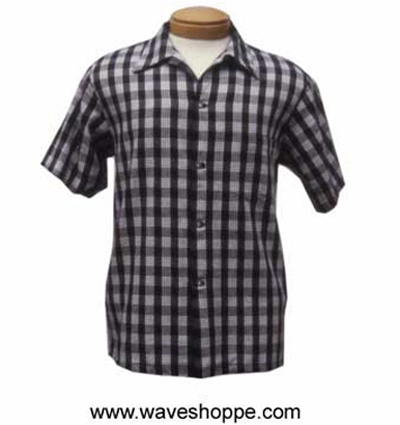 The Hawaiian shirt’s we wear today have a fascinating beginning, it begins with a Hawaiian staple using a unique material named Tapa, which was used in the making of Palaka shirts. Think of Hawaii and the first thing that comes to mind is Hawaiian shirts. This well known garment is the descendant of the Palaka shirt and has a long history.